Showing posts with label Jane Austen. Show all posts

Friday, 6 April 2012

Jane Austen's Sense and Sensibility: Screenplay and Diaries ~by Emma Thompson

In 1995, Emma Thompson did a very good thing.  Not only did she devise, write and act in a film adaptation of Jane Austen's wonderful romance novel, 'Sense and Sensibility', but she also published the diaries that she kept during that time.  And what a delightful collection of anecdotes and  observations they are.

As you might expect from Emma Thompson, this is a hilarious book, full of witty, self-deprecating remarks that we have come to expect from this clever, entertaining and funny woman.  A taste: 'Bed with the script, Austen's letters, a sore back and wind.  Inside and out.'  This book is awash with wonderful one-liners.   
 She describes the first rehearsal with Kate Winslet and Gemma Jones (Mrs Dashwood), and director, Ang Lee: 'Rehearsals with Gemma and Kate.  Both surprised to find that Ang begins with meditaion and exercises - this is not usual. We sit on cushions and breath... Loud screams, particularly from Winslet.'


It strikes me that Thompson is very much like Elizabeth Bennet who is described by Mr Darcy as taking great enjoyment 'in professing opinions that are not (her) own'.  In fact, Ms Thompson's tongue is firmly stuck in her check most of the time.  And, in this regard, she is the sister that Jane Austen should have had.  Her style of writing mimics Austen's own gentle ironic style, as she forces the reader to focus on what is not said and what is communicated only between the lines.  Thompson seems to have an innate understanding of Austen's feelings and brilliantly captures the vulnerability of these women in reduced circumstances and also the passion and depth of feeling that the sisters embodied.  And after all that she still manages to demonstrate their lively intelligence and that of the author.

Thompson tells us in the book that she edited and re-wrote certain scenes of the film with the voices of the actors ringing in her ears, once the roles had been cast.  You can easily imagine this with such distinctive actors as Hugh Grant, Alan Rickman, Harriet Walter (Fanny Dashwood) and Imogen Stubbs (Lucy Steele). But it is Kate Winslet who, rightly, steals the show.  After the first day of shooting Thompson says of her:
'Kate looks a bit white.  The bravest of the brave, that girl.  I can't imagine what sort of a state I would have been in at nineteen with the prospect of such a huge role in front of me.  She is energised and open, realistic, intelligent and tremendous fun.'

As for her old friend, Hugh Grant, Thompson is forever teasing and flatteringly unkind.  Consider her remarks of him:
 'Hugh Grant arrives tomorrow but I've nicked the prettiest room'. Or, 'Hugh grant walks in... repellently goregeous, why did we cast him? He's much prettier than I am.' 
In truth, she loves him dearly and often comments on his fine acting performance.  The more astute  of you may notice the anomaly in the photograph opposite, which shows a kiss that never took place in the edited film version.  But it does happen in the screenplay.  As Edward and Elinor finally come together and reveal their mutual feelings of love, there occurs a tiny, beautifully written scene, complete with a kiss.  If you want the tantalising details, you must go to the book!  
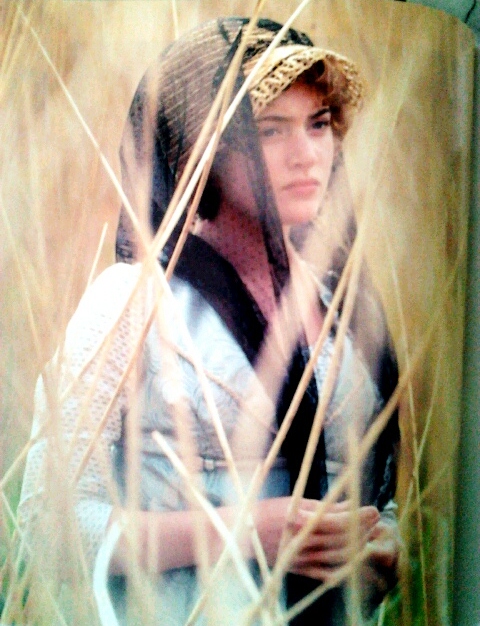
For Emma Thompson walks the oddly uncomfortable yet fine line between the grown-ups and the children, the production team and the acting talent.  She has a foot in each camp and it is very enjoyable to observe  her lady-like efforts to maintain the balance between the two.  Here is just one example.  Director Ang has gathered the cast together at the end of the day's shoot.
'We're asked to do written homework for Ang. This is also unusual, he wants character studies and sets a list of questions, mostly addressing..."inner life... imogen Stubbs (Lucy Steele) wins prize for best effort..". '  
 You can just about hear the suppressed laughter bubbling to the surface in this sentence.  Like a school girl, trying to be good really, but succumbing to the infections giggles of her classmates, Thompson remains serene but at any moment you just know she is about to explode in uncontrollable fits of laughter. And this light-hearted giddiness is the overall tone of this most beautiful of books.

The diary is also interesting in that it recounts Thompson's burgeoning relationship with actor Greg Wise,
 the man who Thompson would later marry and have a child with.  His first mention in the diary is particularly worth a closer look:

'Sunday 30 April 8:20 a.m..... Greg Wise (Willoughby) turned up to ride, full of beans and looking goregeous.  Ruffled all our feathers a bit'.  

How wonderfully inderstated. (They fell in love on the set apparently.)  Gone are the comments about the freezing cold weather and the miserable outdoor shots.  Her next notes says:
 'Sunday 30 April 7:30 p.m. ... 'fantastic outing, sunny drives, five courses at ... hotel and skinny dipping in the river.'  Sounds like love to me.  Go Emma! 
'Sense and Sensibility, the Screenplay and Diaries' by Emma Thompson, is one book that just would not work on a Kindle.  The stills alone, some of which you can see here, are to die for.  They are taken by gifted photographer Clive Coote who succeeds in creating little portraits that look just like paintings; framed moments of beauty, that are quite breath-taking and very much in-keeping with director Ang Lee's artistic sensibilities.
 I do not keep this book shut-up tight on my bookshelf, but have it sat upon a book stand, open at various pages during the year, depending on my mood.  It is a work of art, made for dispaly, so display it I do.

And here I will leave you, with a very Austenesque line taken from the Thompson diary, as parting gift.  Emma writes:
 'Ang wants sheep in every exterior shot and dogs in every interior shot.  I've suggested we have sheep in some of the interiors as well.'  
If you do not own this book by tea-time,  as any self-respecting Austen fan should, 'I shall swallow my own bonnet!'  Go buy this wonderful object and enjoy every picture and every word.  It is all the chocolate you will need this Easter!
By Michelle Burrowes

Friday, 6 January 2012

Death Comes to Pemberley ~ P.D. James


It is a truth, universally acknowledged that 'Pride and Prejudice' sequels are usually best avoided at all cost, but not so with P.D. James's 'Death Comes To Pemberley'. It is a rare thing to finish a novel with such a sense of contentment as I feel on finishing this delicious book.  Using the obligatory chocolate analogy, one would have to say that this book has all the feel of Galaxy chocolate, but with a slightly different flavour to it.  Mint or perhaps cinnamon? 
The true wonder of this book is how well ninety-two year old novelist P.D. James captures the nuances and sensibility of Jane Austen's writing-style. Her diction is almost an exact match, with her pages of dialogue being the most impressive.  There is not a syllable said by either Darcy or Elizabeth, now somewhat jarringly referred to as Mrs Darcy, that Austen herself could not have written.  It is clear that James researched her subject meticulously, indeed she is herself a self-confessed Janeite and an Austen aficionado of the highest order.
For me, P.D. James is to Jane Austen documentaries what Dame Judi Dench is to period drama: you really can't have one without the other.  So to learn that James had decided to write the one definitive 'Pride and Prejudice' sequel seemed too good to be true. The result was an overwhelming success and from here on in, a line can be drawn under the whole Jane Austen prequel/sequel phenomenon.  Quills down ladies - we have a winner!
Let us consider the plot of James's novel.  Without giving anything away, there is a murder at Pemberley some six years after Darcy and Elizabeth have set up home together.  There is an inquest and a trial and that is it.  In some ways the book begins and ends in the same way as 'Pride and Prejudice', with the arrival of a gallant stranger into the neighbourhood, with questions of the suitability of a possible suitor, and an ending very much in keeping with the Austen conventions that we are familiar with.
Yes,the plot is indeed that simple, but as with Austen, the real delight for the reader is the interplay of characters and the sparkling dialogue.  In this especially, James has kept true to the original style of the 'mother' novel.  It is simply delightful to hear Elizabeth and Darcy re-visit moments from their past and take up where they left off from 'Pride and Prejudice',as if the intervening two hundred years, were as unimportant to the reader as an ad-break to modern television audiences.  Similarly, characters like Jane and Mr Bennet wander into the story, using the phrases and idioms that we have long associated with these characters, and one cannot help but smile to hear them chime together in a worthy novel once more.  
And the resurrection of such familiar characters is not limited to the pages of 'Pride and Prejudice'.  No indeed! We hear mention of Emma and Mr Knightley, Harriet and Robert Martin, from 'Emma' and Sir Walter, Anne Elliott and Captain Wentworth from the posthumous novel 'Persuasion', which serves only to enhance the pleasure for the more avid Austen fans.  Indeed, aspects of the story reflect other novels too, such as 'Sense and Sensibility' and even 'Mansfield Park', but to mention them here might impinge on the enjoyment of others.  
One aspect of the novel which is entirely James's own, is her knowledge of the legal system during the Regency period,and an in-depth knowledge of the the physicality of murder and the damage that a blunt weapon can inflict on the human body.  But fear not, this is not such a gruesome tale as all that, and the 'death' of the title, it seems to me, reflects more about the death of Darcy's pride than of anything else.  He is forced to face the flaw that almost cost him his happiness with Elizabeth in the original text and to put old grievances finally to rest. 
Similarly, the atmosphere of the novel is also true to Austen's style.  It glides along at a slow, elegant pace, with the quiet ease of satin-soled slippers on a marble floor.  And it is this aspect of the novel that separates this sequel from all others.  Being a novelist of such a high standing herself, P. D. James has, perhaps, not the pressures that less well-known, younger writers might have, believing that their novels must be rip-roaring page-turners if the reader is to remain engaged.  Here James shows her master card; being of a generation that was born between the World Wars, where life did move at a slower pace than today, James can easily slip into the more authentic Austen style of writing, where life moves to a more leisurely rhythm, which is something to be relished and enjoyed in such a novel.
The resulting effect of all this mimicry and mirroring, is to create a sense that the shadow of Jane Austen lurks amid the pages of this fine book.  It is as if the long dead Jane is standing just behind the shoulder of the author, guiding her hand and smiling.  There is nothing here to offend the staunch J. A. fan, so feel free to dispense with the guilt that Austen fans often feel as their hands reach out for the latest 'Pride and Prejudice' sequel.  I often worry that I should not be wasting my time with some second rate sequel when I could be re-reading an Austen original.  Yet here, we can have all of the enjoyment and none of the regret:  we can return to Darcy and Elizabeth, while savouring the joys of a highly crafted novel by one of the great living writers in the English language.  It's chocolate, but without the guilt?  Now there's a novel thought.  

4 of 5 stars


Monday, 28 March 2011

Me and Mr Darcy ~ Alexandra Potter

Ok..I have to admit that I bought this in a moment of madness because I loved the cover and knew it would look good on my bedside locker... and it was my birthday! A few chapters in and it was a bit silly... but by the end it really was disappointing.
 Nothing very much happened except that the central character, Emily Albright,  kept meeting Mr Darcy, the actual, literary character from Pride and Prejudice. He was from the 18th century - britches, coat tails and riding crop included - and was very confused by her dress, her language and the fact that she didn't have servants.   Of course there was a delightful scene where he takes her for a midnight horse-ride to a castle, and I'm sure there was a moment when the poor man fell into a pond and got his shirt all wet... but when she began to think him a bit boring and wished they could have a good natter about the 'X Factor or American Idol... or something' , that was when I should have called it a day.  I only finished it because I hate to leave a book unread and how I begrudge those wasted hours now! 
One line from the text reads something like: '...there are Jane Austen fans and there are Jane Austen FANS...'  Here, the narrator admits that she wasn't the latter.   It says so much.  
I think this is a book for those who have watched the Kiera Knightley movie of Pride and Prejudice perhaps and have heard of Colin Firth - not for those who actually love  the book.  I spent most of my time thinking why am I reading this when I could be reading Jane Austen!  A good title, but a wasted opportunity. Stylistically, it was quite teenage in it's simplicity, although the central character is meant to be almost 30 years old.  It just shows the power of a good cover to sell books... which was by far the best thing about this one.  What can I say, I was sucked in by the marketing.  My apologies Miss Austen, for ever going astray .  
My advice to you would be to give it a miss and read the original text instead


didn't like it (my current rating)it was okliked itreally liked itit was amazing


Saturday, 19 February 2011

Pride and Prejudice - just another love story?

What I like about Pride and Prejudice is that it is not simply a book about love. Money matters are at the heart of it. We have a group of women who depend on marrying well to guarantee their financial security. Mrs Bennet is keenly aware of her responsibility to find wealthy husbands for her daughters as she cannot make them financially secure herself. Mr Bennet seems incapable of grasping the urgency of the matter, and keeps to his library rather than seeing his daughters wed.

Austen is at pains to point out how annoying Mrs Bennet is and how tiresome the daughters find her. However, it cannot escape our notice that Lizzy's affections for Darcy changed as soon as she sees his big estate in Derbyshire and she jokingly admits to Jane that she must date her falling in love with Darcy from that point.

In fact, she does indeed fall in love with a wealthy man, and does, in fact, exactly what her mother would have wanted her to do. Perhaps the years of listening to her mother's plots for marrying them off has subliminally effected her. In this way, Austen shows herself to be very practical and not at all like the fairytale romance novelist that some readers consider her to be.

Charlotte Lucas, another clever female character, is similarly practical when it comes to affairs of the heart and secures her independance in the world, through matrimony, all be it a less than perfect union. Jane too marries a financially secure man with whom she has fallen in love. Indeed, she is so good, how could Austen deny her that? It is only Lydia, the youngest daughter who broke with all the social norms of the day, and ran away to live with Wickham outside of wedlock, who is unfortunate enough to be bestowed with an impoverished husband. It is clear that Austen punishes her for her unruly behaviour and for disgracing her family.

So, if we consider what advice Pride and Prejudice holds for young women, it is clear that Austen is nothing of not pragmatic: make sure you fall in love with someone who is wealthy, if you want a happy life, the happiest life.

What I love about the novel is that the more you read it, the more you see in it and the more you understand how comlicated the text really is.


Jane Austen's Guide to Dating - by Lauren Henderson

Contains Austens 10 principles for dating: ‘What Not to Do!’ and ‘What to do Instead!’… all gleaned from the novles of the master-writer herself.  Here

is a sample of chapter headings:  'If you like someone, make it clear that you do'; 'Have faith in your own instincts'; 'Don't settle - Don't marry for money, or convenience, or out of Loneliness'.... etc. and my own particular favourite: 'If your lover needs a reprimand, let him have it'.  


Friday, 18 February 2011

From Jane Austen’s ’Mansfield Park’ - 1957 edition:


Fanny at the window …’astonished to see Mr Crawford!’

The Private Diary of Mr. Darcy by Maya Slater

The Private Diary of Mr. Darcy: A NovelI enjoyed reading this version of the Lizzy - Darcy affair, from Darcy’s point of view, simply because I enjoy all things Austen.  However, the author does add a few creative detours regarding the plot line of Pride and Prejudice, most specifically with regard to Darcy’s friendship with Lord Byron.  This idea is quite interesting.  As Darcy and Bingley did mix in the same society as the infamous poet, it is entirely probable that they may have known each other.  They certainly both were uncommonly fond of their sisters, although Byron, perhaps, took that sentiment to extremes, one might say.  
However, I cannot allow the idea that Darcy was 'tinkering' with the girl from below stairs in his bedroom, while Lizzy and Jane slept a few bedrooms away in theirs, during their stay in Netherfield.  It is shocking even to consider!  But, undoubtedly, the temptation to write a few passionate, period 'love scenes' for Darcy was obviously too great to resist. 
Yet, perhaps, Darcy would have been a man of the world, although I think his distaste for Wickham's wild behaviour while at college, would seem to suggest that he was above such clandestine activity and in his friend's house too! 
 Still, it was interesting to revisit Austen's story from a different perspective, especially noting when first Darcy began to fall for Lizzy and how he was wonderfully oblivious to Caroline Bennet's obvious (and desperate) attempts to flirt with him.  This was particularly enjoyable and clever too, as it was somewhat reminiscent of Austen's tongue in cheek style.  It was wonderfully pleasing to see what Darcy could not see, knowing, as we do, how Caroline desired him for a husband.  He is tantalizingly close, but just out of her grasp.  Poor Caroline!
This is not a serious book, but rather a bit of fun between reads, and for that I recommend it to all Darcy fans and deserving friends!

The Private Diary of Mr. Darcy: A Novel

The Jane Austen Book Club by Karen Joy Fowler

There is just so much of interest for the Jane Austen fan in this novel. Every character, every plotline, mirrors one created by Jane Austen.

So, if the character hosting the book club is reading Pride and Prejudice, say, you can be sure that her personal circumstances are similar to those of Lizzy Bennet etc. It happens every time.  There are many, many Austen echoes running through the novel.  Even some of the characters names come from the original texts. (I wont give all the references away - half the fun is discovering the little nods to Austen yourself!)

It was great fun seeing how Karen Joy Fowler managed to turn the stories inside out, to make them fit together; to propel them into the modern period.
For that alone, I found it most enjoyable. It was cleverly done and most of the time I didn’t find it overly-contrived or laboured.

This book contained a wonderful array of characters, each dealing with their own set of problems and struggling to keep on top of things.  Mothers, daughters, brothers and fathers - they are all here.  But above all, this is a book about friendship and how a group of strangers come together because of their interest in Jane Austen.

To truly love or appreciate this book, you need to love, or at least know, the works of Jane Austen. Otherwise, so much is overlooked. I’d happily recommend it to Austenites… but to anyone else, I might suggest looking at Austen herself first, before reading.